What is the charge on the common ion formed by an atom of:
Monatomic Ion Formulas
Ionic compounds contain ions, species that carry a positive (cation) or negative (anion) charge. An atom carries no charge because it contains an equal number of positively charged protons and negatively charged electrons. When a single atom gains or loses one or more electrons, the number of electrons and protons is no longer equal and a monatomic ion is formed. The charge on an ion is indicated using a superscript to the right of the element symbol. When the charge is +1 or -1, it is written without the number 1. For example, magnesium forms a cation, Mg²⁺, when it loses two electrons, and bromine forms an anion, Br⁻, when it gains one electron.
You need to know the charges of common monatomic ions. Fortunately, most can be determined by their position on the periodic table.
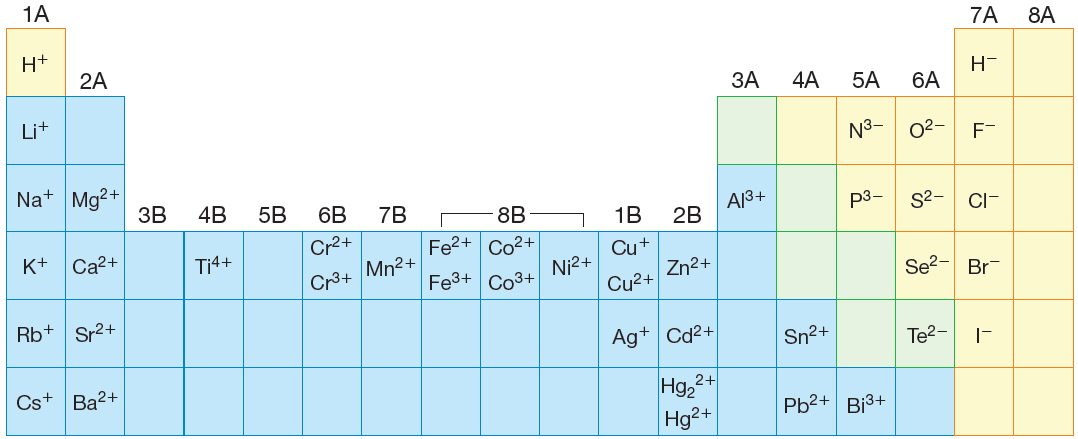
Predicting Ion Charge Based on Periodic Group
Here are the rules:
-
1
Metals in Groups 1A, 2A, and 3A form cations that have a positive charge equal to the group number of the element.
Example: Sodium, Group 1A → Na⁺ Calcium, Group 2A → Ca²⁺ -
2
Nonmetals in Groups 5A, 6A, and 7A form anions that have a negative charge equal to 8 minus the group number of the element.
Example: Oxygen, Group 6A → O²⁻ Bromine, Group 7A → Br⁻ - 3 Other elements form ions with charges that are not easily predicted.
Hydrogen:
Forms both H⁺ and H⁻ ions.
Transition metals:
Typically form cations with charges ranging from +1 to +3. Many transition metals form more than one monatomic ion.
Group 4A:
Contains both metals and nonmetals, so some elements in this group form cations and others form anions. Some do not form ions at all.
Groups 3A, 4A, and 5A metals:
Other than aluminum, the metals in these groups form cations with positive charges that are not easily predicted.